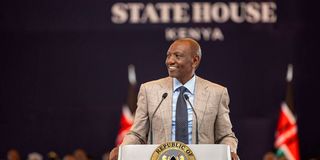
President William Ruto recently argued that freedom and democracy without transformation and development are meaningless. In the immediate post-colonial era, African leaders used this false dichotomy between development and democracy to justify tyranny. Essentially, this argument claimed that democracy and multiple parties were inherently disruptive of the development process. The leaders also used cultural relativism to justify misrule.
They postulated that democracy and human rights were not universal concepts. These ideas, they argued, varied according to cultural context. For instance, they pointed out that African traditional governance system was “consentaneous,” not adversarial. They repeated the romantic idea, propagated by Pan-Africanist ideologues at our universities, that, in pre-colonial Africa, people and their rulers would argue under a tree for days until consensus was reached.