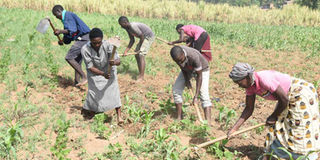
Farmers cultivate maize on a farm in Kakamega, western Kenya. Agriculture, which accounts for more than one third of the national GDP for 2019 slowed to 3.6 percent compared to six percent the previous year. PHOTO | ISAAC WALE | NMG
Climate change is already putting huge stress on Africa’s food production systems. And, according to projections, worse is coming. As Ministers for Agriculture from across the continent gather in Kigali, Rwanda, from August 5th to 6th for the Africa Food Security Leadership Dialogue, ensuring a secure and sustainable food supply must be at the centre of their minds.
Over the past 20 years, Sub-Saharan Africa’s farming sector has grown faster than anywhere else in the world, with an average 4.6 percent agricultural GDP growth rate from 2000 to 2018 – that’s 1.4 percentage points higher than any other region. Thanks to infrastructure advances, such as roads and telecommunications and an increase in farm sizes, farmers are becoming better connected to markets to sell their crops and livestock at better prices and to obtain inputs and services such as seeds and insurance.